

Gathering Matters
I recently (March 12) ran across a very interesting social media post on X by Ryan Burge. Dr. Burge is a former pastor, Professor of Practice at Washington University in St. Louis, and is a leading data analyst on religion and politics in America. He regularly takes the pulse of the church in areas like church growth and decline, the rise of “nones,” faith and voting, among other topics and writes for outlets like The New York Times, Politico and The Wall Street Journal along with his popular Substack newsletter on Graphs about Religion.
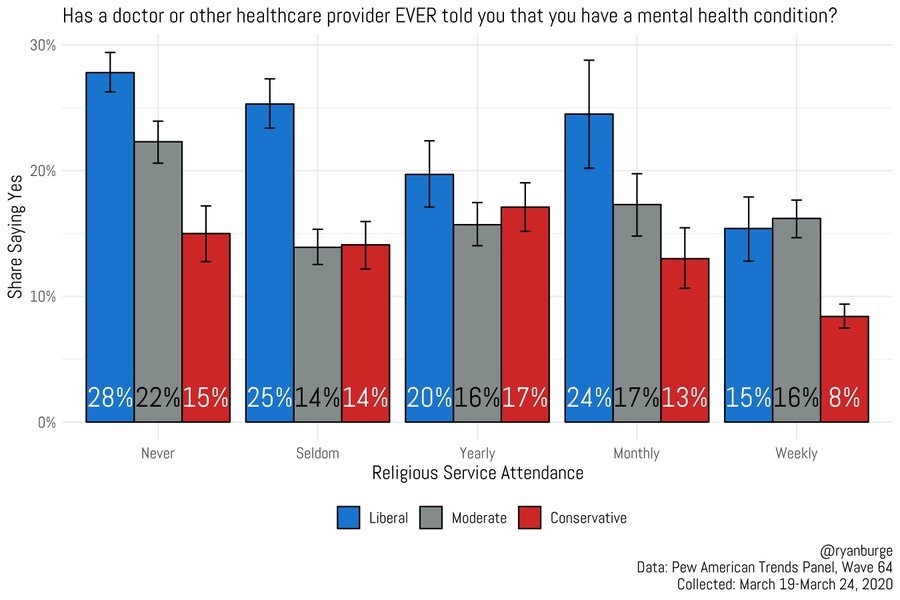
Here is what Dr. Burge shared in his recent post along with the graph below: “Conservatives who attend church weekly are the least likely to have ever been diagnosed with a mental health condition. Liberals who have low attendance are the most likely to have a diagnosis.”
Over the years, there has been a variety of fascinating research data shared about the benefits of being a Christian and regular involvement in a local church (sources: Gallup, Reachrightstudios.com, Barna Group, Pew Research Center, Wall Street Journal, Churchtrac.com, graphsaboutreligion.com, Lifeway.com, Harvard School of Public Health).
What the data reveals about the benefits of being a regular attender in a local church:
Better mental and emotional health: There is higher happiness, lower rates of depression and anxiety, greater sense of purpose and meaning, and regular attenders show higher “flourishing” scores.
Better social and relational health: There are stronger support networks, reduced loneliness, greater marital stability, increased intergenerational connection.
Better physical health and longevity: Consistent findings of lower mortality rates among weekly attenders (20–30%), lower rates of substance abuse, suicide, and better overall health outcomes.
Better moral and behavioral formation: There are higher rates of volunteering, generosity, civic engagement, and lower rates of crime and stronger family structures.
Better family and child outcomes: Children raised in regularly attending homes are more likely to have better emotional resilience, avoid high-risk behaviors, and maintain long-term faith continuity especially when these outcomes are lived at home and parents show authentic faith, not nominalism.
Better spiritual health: While social science measures temporal benefits, we find Scripture telling us there will be beneficial growth in community together (one anothers: Heb. 10:24–25), mutual edification (Eph. 4:11–16) and participation in the means of grace (Word, fellowship, ordinances, accountability, service, etc.).
What the data reveals about the average actual attendance behavior among people who consider themselves churchgoers: they attend 1.6 times per month. Nationally, 31% of Americans attend church weekly, 10% about once a month, 57% seldom or never attend (Gallup).
What God says our gathering attendance should be: “and let us consider how to stimulate one another to love and good deeds, not forsaking our own assembling together, as is the habit of some, but encouraging one another; and all the more as you see the day drawing near" (Hebrews 10:24–25).
As the saying goes: “Father knows best” (that is, our heavenly Father). What social science observes as benefits, Scripture presents as God’s design for human and spiritual flourishing. Too many (the 1.6x per month attender) are missing out on some great benefits, mainly the benefit of regularly gathering together to worship the Lord in all its expressions (e.g., worship by greeting, singing, praying, giving, fellowshipping, serving, partaking the Lord’s supper, baptizing, and learning the Word of God).
So, what needs to change in your life in order to become more faithful in gathering and ministering to and with God’s people?
Pastor Jeff
25. What offices does Christ perform as our Redeemer?
Christ, as our Redeemer, performs the offices of a prophet (who reveals God’s truth),of a priest, (who intercedes for us), and of a king (who rules, defends, and conquers all), both in His earthly humiliation and heavenly exaltation (Acts 3:22; Hebrews 5:6; John 1:18; Hebrews 2:17, 7:25; Matthew 2:6; Luke 1:32-33; 1 Corinthians 15:25)